
Fish residuals may hold the key to male fertility
13.4.2026 08:44:21 CEST | Nofima | Press release
Nofima scientists are developing fertility supplements for men made from salmon heads.
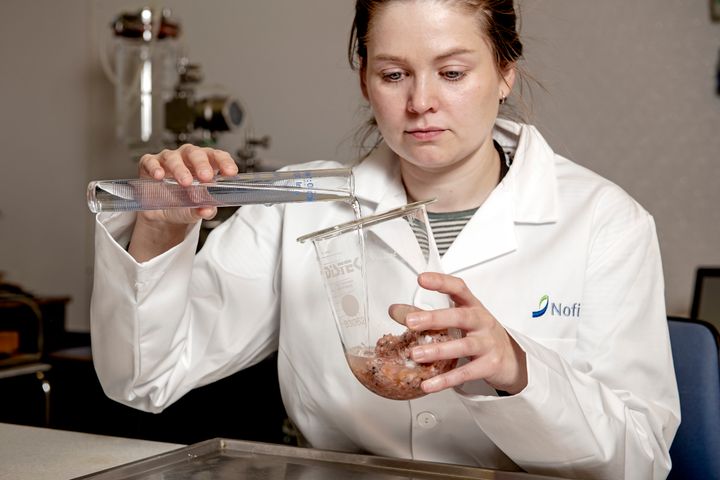
Senior Scientist Tone Aspevik at Nofima has spent several years studying the potential of salmon heads.
Birth rates across Europe are declining, and so is male fertility. Fertility problems affect around 17 % of Norwegian men.
Could part of the solution lie in the past?
In earlier times, we consumed a much larger share of the fish than we do today. Nowadays we mostly eat fish fillet, but new research shows there are significant health benefits in eating parts such as skin, tendons and bones.
“Across several research projects, we have found positive health effects from protein powder made from salmon heads. The powder has proven beneficial for skin, hair and mental health,” says Senior Scientist Tone Aspevik at Nofima.
Now, the research team has reason to believe that salmon head proteins may also improve sperm quality, and thereby increase male fertility.
Protein powder production
Using advanced biotechnology, the researchers extract a protein powder with the right texture and flavour.
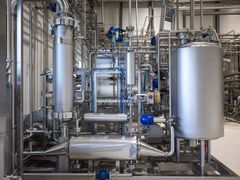
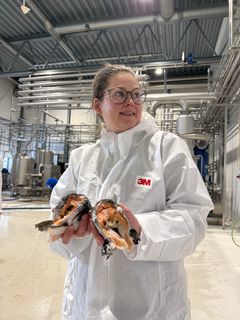
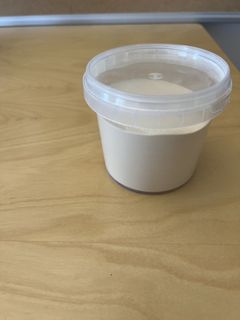
“At Nofima’s pilot plant, Biotep, we use state-of-the-art equipment to refine the salmon heads into an extremely pure protein powder,” Aspevik explains.
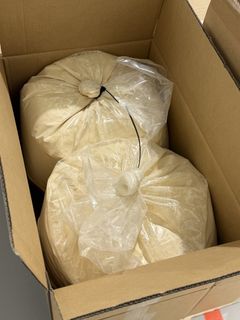
The resulting powder consists of more than 95 % pure fish protein and minerals such as sodium, potassium, phosphorus and calcium.
Using every part of the fish
One reason Nofima’s scientists refine the salmon heads into protein powder is that it makes consumption easier. The material is broken down in a way that releases its bioactive properties. This approach also means that nothing goes to waste. The residual raw materials remaining after the protein powder is extracted are used for new products.
“We send fish bones to Italy to test their potential use as an ingredient in sunscreen. The extracted oil can be used in feed ingredients, while the process water is used to cultivate microalgae,” says Aspevik.
In this way, scientists have managed to utilise every part of the fish, creating added value and new high-quality products.
About the research
At Nofima in Bergen, the scientists tested a variety of processes based on salmon and cod. The bioactivity of the resulting products was first studied in cell culture before moving on to animal testing with project partners in Greece. Following a well-documented process, the team received authorisation to conduct trials on humans.
The protein powder has now been produced and will be sent to Lund University in Sweden, where volunteer participants will test the supplement.
The BLUEWAYSE project
Nofima coordinates the EU project BLUEWAYSE, funded through the Sustainable Blue Economy Partnership, co-funded by the European Union (Horizon Europe) and national funding agencies, including the Research Council of Norway.
The project’s goal is to develop new ways of fully exploiting all residual raw materials from fish. Scientists use these materials to create high-end products. After the fish is processed, the remaining bones, oils and proteins are used to develop products such as sunscreen and feed ingredients. Even the process water is repurposed to cultivate microalgae.
About Biotep
Biotep, located in Kaldfjorden outside Tromsø, is Nofima’s pilot plant that produces food-grade products for human consumption. Here, salmon heads are transformed into highly refined protein powder intended for premium dietary supplements.
Keywords
Contacts
Oda BjørnsborgNofima
Tel:+47 40484930oda.bjornsborg@nofima.noImages
Links
About Nofima
The Norwegian food research institute Nofima provides research based knowledge and innovations for actors in all parts of the food systems.

Subscribe to releases from Nofima
Subscribe to all the latest releases from Nofima by registering your e-mail address below. You can unsubscribe at any time.
Latest releases from Nofima
Kvalitetsfeil på torsk koster flere hundre millioner2.11.2026 06:00:00 CET | Pressemelding
Torsken er levert, men får industrien verdifulle ryggstykker eller et billigere produkt når de foredler den?
Én av fem kan ikke lage mat uten strøm30.10.2026 07:00:00 CET | Pressemelding
Hvis strømmen blir borte, kommer mange til å slite med å bli mette. To av ti kan ikke lage mat på propan eller åpen ild, og tre av ti kan ikke vurdere om maten er trygg.
I krise kan norske brønnbåter forsyne mesteparten av landet med ferskvann27.10.2026 05:00:00 CET | Pressemelding
Tenkt situasjon: Vannkilden på stedet du bor er satt ut av spill. Grunnet sabotasje eller forurensing. Det er ikke sånn at en tankbil kan komme og fylle på. Det er rett og slett ikke friskt ferskvann å få tak i. En desperat situasjon. Hva gjør du? Hva gjør kommunen? Norske myndigheter?
Lukt avgjør om kyllingen havner i panna eller søpla2.10.2026 07:00:00 CEST | Pressemelding
Fersk kyllingfilet kan begynne å lukte annerledes før holdbarhetsdatoen er passert, men den satte holdbarhetsdatoen kan også være kortere enn nødvendig. Det viser seg at både bakteriene i fileten og temperaturen under lagring henger sammen med når forbrukere sier nei takk.
Salmon gills respond to climate stress before damage becomes visible25.9.2026 09:07:49 CEST | Press release
Marine heatwaves and more frequent jellyfish blooms pose a threat to farmed fish. A new study by Norwegian and Spanish researchers shows that salmon gills respond rapidly as the sea warms. Marine heatwaves leave biological traces before the fish show any signs of damage.
In our pressroom you can read all our latest releases, find our press contacts, images, documents and other relevant information about us.
Visit our pressroom