
Turning feed inside out: zinc coating gives triple win
10.3.2026 12:12:27 CET | Nofima | Press release
“We should change the way we add the mineral zinc to salmon feed,” says researcher Antony Philip at Nofima. The gains are better uptake and health in the salmon, lower emissions to the environment, and more circular use of sludge.
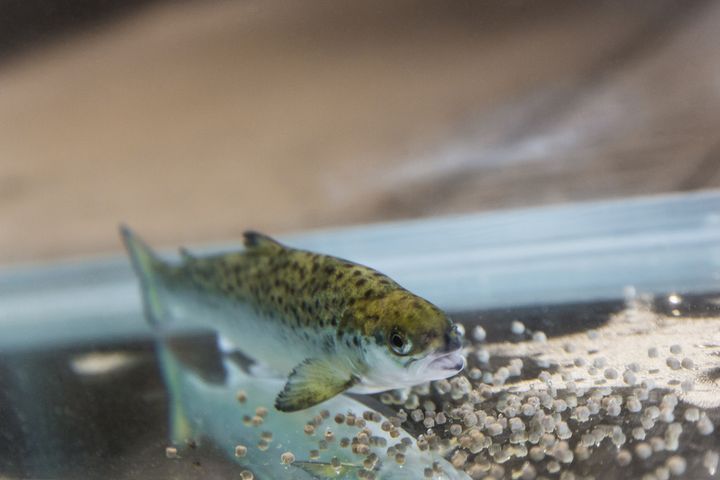
Zinc is a mineral that fish need to stay healthy, for example to repair wounds. The drawback with today’s salmon feed is that the salmon retain a rather small fraction of the zinc, while large amounts are lost straight to the aquatic environment.
The EU wants to reduce zinc emissions to the environment, and the salmon farming industry across Europe is struggling with stricter limits on how much zinc is permitted in the feed, according to Philip.
Today the limit is 180 mg zinc per kilo of feed for salmonids and 150 mg/kg for other fish species. EFSA (the European Food Safety Authority) has proposed lowering the level to 150 mg/kg also for salmon feed.
“The solution is to increase the digestibility of zinc in the feed, so the salmon still gets enough zinc, even if the content in the feed is reduced,” says Philip.
Briefly about the feed process
Today, zinc is added in a premix to the feed blend before it goes through an extruder (a machine that uses high temperature and high pressure) and is turned into pellets. A premix is a blend of micronutrients.
Normally, after the pellet comes out of the extruder, it is coated under vacuum with oils. The oil is then drawn into the pellet, and this allows additives that cannot tolerate high temperature to be included in the coating. Minerals are usually not included in this coating step because they tolerate high temperature well. However, they can still be trapped in rigid protein structures formed during heat treatment.
From premix to coating
“When zinc binds in these structures, it hampers release and uptake in the salmon gut,” explains Philip.
This is why he wants to move zinc supplementation in feed from the premix to the coating.
Philip has worked with mineral nutrition throughout his career. Educated in fish nutrition in India, he holds a dual PhD in mineral nutrition in fish from the Netherlands and France. He was then recruited to Norway to build knowledge on mineral nutrition in salmon. After ten years working on different zinc sources, environmental factors and the salmon’s own zinc physiology, he became convinced that the solution to low zinc uptake in salmon had to lie in the supplementation method.
At the Norwegian research institute Nofima, he was given the opportunity to test a new supplementation method at their Feed Technology Centre. This centre has the equipment and expertise to trial different feed formulations and processes.
Triple win documented in post-smolt
At Nofima he therefore launched an internal project to develop the method and document the effects on post-smolt (salmon between 200 and 280 grams) kept in land-based tanks with seawater.
Here he confirmed that when zinc was added in the coating, zinc digestibility increased by up to 15 percentage points. Zinc in faeces was reduced by up to 25 percent.
If the method is adopted, it will deliver a triple win:
- Better zinc uptake in the fish, which may benefit health.
- Less zinc is lost to the environment because more is absorbed by the salmon.
- Lower zinc concentrations in aquaculture sludge, improving the potential for utilisation and value creation from the sludge.
With the new project TOP-zinc, Philip and his colleagues at Nofima are taking the next step. They will identify which strategies give the best uptake, and how this affects fish health in long-term sea-cage trials. The project is carried out in collaboration with the Institute of Marine Research, Akvaplan-niva, MOWI Feed AS, Huvepharma NV and NIVA. It is funded by FHF – the Norwegian Seafood Research Fund.
Renate Johansen, R&D Director at FHF, confirms that excess zinc in the environment can have a negative impact on the microscopic life around fish farms.
“With climate change, both the need and the awareness that we must minimise our negative impact are increasing,” she says, and continues:
“New EU requirements, which will probably mean that zinc levels in the feed must be limited, could cause deficiency diseases in salmon unless we find a good solution that gets more of the zinc from the feed into the fish and less out into the environment. The industry therefore has high expectations that the TOP-zinc project can help solve this challenge.”
Preparing the industry for new rules
The new method makes it possible to meet the salmon’s zinc requirements even if EU regulations change.
The new regulation has not yet been introduced, and the researchers still have a lot of documentation work ahead of them. Nevertheless, Philip believes that feed companies and farmers stand to gain a lot by testing the method already now in smolt facilities.
“By changing the method, feed companies can help increase uptake, cut emissions and reduce feed costs. In TOP-zinc we are exploring options that can support decisions on zinc supplementation strategies in salmon feed, also in the grow-out phase at sea,” says Philip.
“In the past, poor zinc digestibility was ‘only’ a biological issue, but now it is also becoming an operational challenge, and that makes the interest in finding solutions much greater,” he concludes.
Keywords
Contacts
Reidun Lilleholt Kraugerud
Tel:48197382reidun.lilleholt@nofima.noAntony J. Prabhu PhilipSenior Scientist (Dr.)Ernæring og fôrteknologi
Tel:+47 902 82 079Antony.Philip@Nofima.noImages


Links
About Nofima
The Norwegian food research institute Nofima provides research based knowledge and innovations for actors in all parts of the food systems.

Subscribe to releases from Nofima
Subscribe to all the latest releases from Nofima by registering your e-mail address below. You can unsubscribe at any time.
Latest releases from Nofima
Follo-folk setter sunnhet først2.7.2026 07:00:00 CEST | Pressemelding
De første resultatene fra Follostudien er klare. 825 innbyggere fra de seks Follo-kommunene har fortalt forskerne ved Nofima om matvanene sine. Funnene viser at det bor matglade mennesker i hele regionen, selv om flertallet prioriterer sunnhet over ren nytelse i matveien.
Fatty acid from herring may ease mild psoriasis10.6.2026 10:30:09 CEST | Press release
Laboratory tests on skin cells suggest that the fatty acid omega‑11 can dampen inflammation linked to psoriasis.
Fettsyre fra sild kan dempe mild psoriasis10.6.2026 08:31:06 CEST | Pressemelding
Forsøk i celler fra hud viser at omega-11 demper betennelse i psoriasis.
Økt forbruk av fisk og skalldyr kan styrke Nordens beredskap9.6.2026 14:32:39 CEST | Pressemelding
En nordisk studie viser at fisk og skalldyr fra hav og ferskvann har et uutnyttet potensial i nordisk matberedskap. Utfordringene er å få til effektive forsyningskjeder, og å få folk i Norden til å spise sjømaten.
Klare råd for å få ungdom til å velge sjømat20.4.2026 14:45:45 CEST | Pressemelding
Prioriter pris! Få bort fiskebein og vond lukt. Og få influensere på banen!
In our pressroom you can read all our latest releases, find our press contacts, images, documents and other relevant information about us.
Visit our pressroom