
Three months shorter production time
11.12.2025 07:00:00 CET | Nofima | Press release
Selective breeding is a powerful tool to enhance desirable traits in fish and livestock - a fact well established in the industry. Now Manila clam has its own dedicated breeding programme.
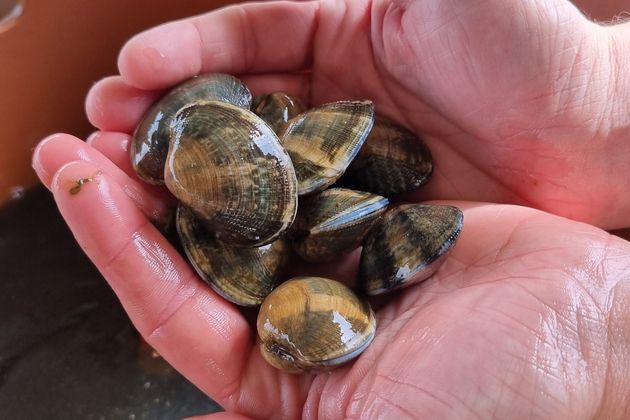
Manila clam, or Ruditapes philippinarum in latin, is cultured in Italy by the company Naturedulis. Naturedulis, based in the nutrient-rich Goro Lagoon, operates a hatchery for clams. The company supplies juvenile clams to other shellfish farmers in the region. Their ambition was to harness the natural potential of these clams through selective breeding, enabling better utilisation of the lagoon’s nutrients and boosting production.
This ambition has become reality through a project called Bivalvi. The basis of the breeding programme builds on Naturedulis’ and its customers’ expertise on clams, combined with Nofima’s experience in breeding science.
At the beginning of 2025, farmers began seeding the first clams selected specifically for rapid growth.
“We expect these clams to be market-ready by Christmas 2025, slashing the production cycle by at least three months,” said Leonardo Aguiari of Naturedulis in November.
He added that the Bivalvi project has been pivotal for the Italian hatchery Naturedulis and local clam-based economy.
Since the 1960s, Nofima has worked to develop breeding programmes for a wide range of species in collaboration with industry partners. This includes cold-water species salmon and cod, as well as the warm-water tilapia. The sophistication of these programmes varies and develop over time.
“Manila clam is the latest species to benefit from breeding work by Nofima’s geneticists,” says project leader Anna Sonesson.
She is proud to be involved in breeding a low-trophic species such as clams:
“Shellfish breeding is not common in Europe. Even though a driver of sustainable food production is to move down the food chain, there is still very little breeding of low-trophic species. This means missing out on improved production efficiency, health, quality and lower mortality,” Sonesson explains.
The Bivalvi project is funded by ERA-NET BlueBio. Nofima has collaborated with Naturedulis and the University of Bologna.
Keywords
Contacts
Reidun Lilleholt Kraugerud
Tel:48197382reidun.lilleholt@nofima.noAnna SonessonResearch DirectorAvd. Avl og genetikk
Tel:+47 64 97 04 03Tel:+47 930 98 047anna.sonesson@nofima.nonofima.no/ansatte/anna-kristina-sonesson/Images
Links
About Nofima
The Norwegian food research institute Nofima provides research based knowledge and innovations for actors in all parts of the food systems.

Subscribe to releases from Nofima
Subscribe to all the latest releases from Nofima by registering your e-mail address below. You can unsubscribe at any time.
Latest releases from Nofima
Klare råd for å få ungdom til å velge sjømat20.4.2026 14:45:45 CEST | Pressemelding
Prioriter pris! Få bort fiskebein og vond lukt. Og få influensere på banen!
Har du nok mat i beredskapslageret?16.4.2026 06:30:00 CEST | Pressemelding
Lurer du på hvor mye du skal handle til beredskapslageret? Her får du Nofima-forskernes råd om hvilken mat, og hvor mye mat som er lurt å ha dersom en krise oppstår.
Fish residuals may hold the key to male fertility13.4.2026 08:44:21 CEST | Press release
Nofima scientists are developing fertility supplements for men made from salmon heads.
Lite kunnskap om hva laksen spiser9.4.2026 11:01:27 CEST | Pressemelding
Visste du at om lag 70 prosent av fôret til oppdrettslaks består av planter? Hvis ikke, er du i godt, internasjonalt selskap.
Slik skal de øke fertiliteten hos europeiske menn30.3.2026 05:00:00 CEST | Pressemelding
Nofima-forskere er i gang med å utvikle fertilitetspiller til menn laget av laksehoder.
In our pressroom you can read all our latest releases, find our press contacts, images, documents and other relevant information about us.
Visit our pressroom