
Adrián Villar Rojas. The End of Imagination
9.11.2026 14:26:35 CET | The National Museum of Norway | Pressemelding
Adrián Villar Rojas’s monumental sculptures will occupy two of The National Museum in Oslo's Light Halls.
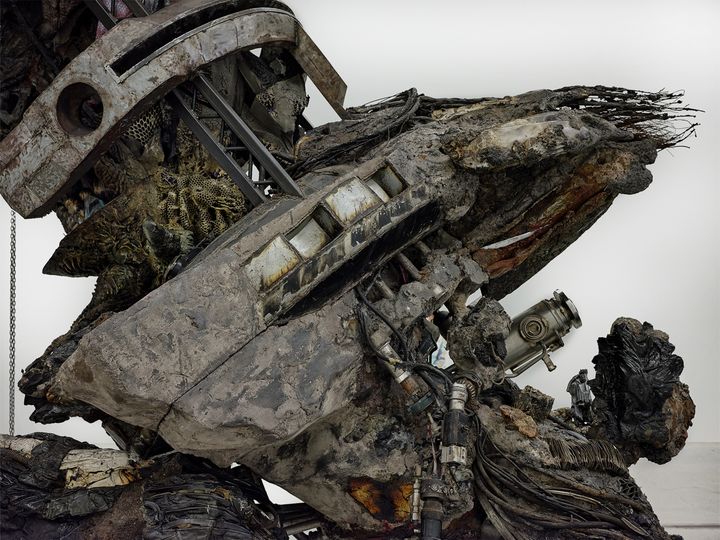
- 19 November 2026–7 March 2027
- The National Museum – The Light Hall
Press preview on 17 November at 11:00 a.m.
Please register by contacting sigurd.lamark@nasjonalmuseet.no
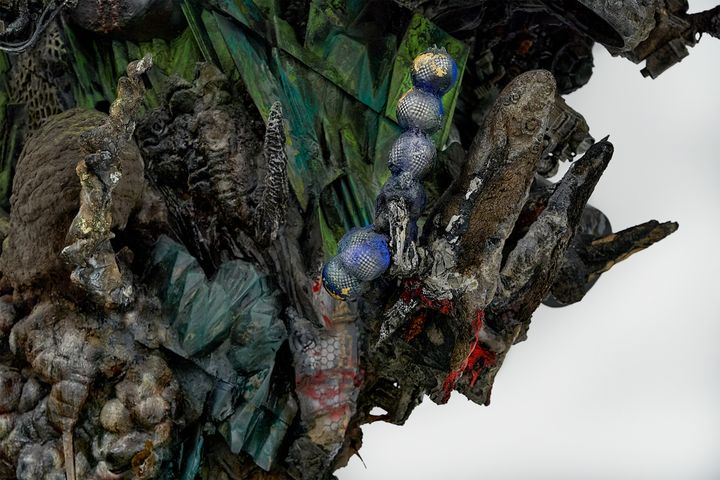
What happens to art if humanity ceases to exist? Is artistic production necessarily tied to humans as a species, or might it survive even without us? What would our world look like when we’re gone? These are some of the questions that reverberate when one encounters the practice of Villar Rojas.
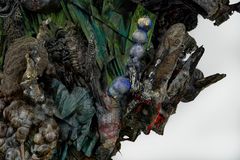
The exhibition will bring together a constellation of sculptures from Villar Rojas’s series The End of Imagination, whose haunting, otherworldly forms appear excavated from an unknowable future.
‘Adrián Villar Rojas. The End of Imagination’ is the Argentine-Peruvian artist’s first exhibition in Norway and the first major presentation of these works in Europe.
In 2020, Villar Rojas and his team developed the Time Engine, a software system designed to explore the conditions of imagined worlds. Combining procedural modelling, simulations of environmental and material processes, and speculative models of economies, societies and conflict, the system terraforms detailed synthetic worlds. Across periods ranging from hours to millions of years, organisms, architecture, machines and geological matter are shaped by changing climates, systems of exchange, struggles over resources, and the emergence or collapse of civilisations. The artist develops the conditions within which these worlds evolve, drawing sculptural forms from the histories that unfold within them.
Earth generates forms of astonishing complexity: insects, trees, rocks, even the machines through which new forms come into being. Villar Rojas’s digital ecologies extend this generative logic into imagined worlds. The End of Imagination recasts the creative act: what might art look like when no single intelligence is its author, when form emerges from the innumerable forces of a world acting upon itself? The artist retrieves objects from these realities and gives them material presence in ours. As Villar Rojas says: ‘I model worlds, and these worlds model “sculptures” for me.’
Translating these digital forms into physical existence involves an extended process of research and fabrication. In a temporary workshop in Rosario, Argentina, the artist and his team developed materials, tools and construction techniques to reconcile the forms with terrestrial gravity, scale and structural stability. Concrete, glass, salt, wax, resin, plastics, wood, motor parts and organic matter are assembled in successive layers, producing surfaces that recall mineral formations, industrial residues and the remains of monuments. Their apparent age and unfamiliar anatomy emerge from the accumulated decisions and labour of the people who build them.
What happens when an institution built to interpret the past when the objects it holds come from histories that never happened? The sculptures have the physical weight and complexity of factual things, yet have no place in the chronology through which we make sense of the world. Here, the museum itself becomes both a setting for that inquiry and one of its subjects.
The End of Imagination belongs to a long history of human attempts to think beyond our limits. Gods, art and mathematics have allowed finite minds to conceive of realities they cannot directly experience. Yet every sculpture depends on human judgement, material knowledge and collective labour to come into being. At a moment when AI promises or threatens to automate creation, Villar Rojas makes the act of bringing something into the world insistently visible. Who imagines, who builds, and who determines the conditions of creation remain profoundly human questions.
‘I chose to step completely outside of the human timeline.’
Adrián Villar Rojas
Kontakter
Sigurd LamarkThe National Museum of Art, Architecture and Design
Tel:+47 41574172sigurd.lamark@nasjonalmuseet.noBilder

Følg pressemeldinger fra The National Museum of Norway
Registrer deg med din e-postadresse under for å få de nyeste sakene fra The National Museum of Norway på e-post fortløpende. Du kan melde deg av når som helst.
Siste pressemeldinger fra The National Museum of Norway
The National Museum of Norway announces 2027 programme3.11.2026 17:18:24 CET | Pressemelding
Marking its five-year anniversary, the National Museum’s 2027 programme brings together major international exhibitions, new perspectives on Norwegian art and newly curated rooms in its permanent collection exhibition.
Norwegian craft at the 20th Architecture biennale in Venice 202713.10.2026 10:11:12 CEST | Pressemelding
Decorative painting holds an important place among Norway’s traditional crafts and will form the point of departure for the Nordic Pavilion at the 20th Venice Architecture Biennale. The exhibition, Painted Matter, will explore how traditional craft techniques can shed new light on questions relating to the use of materials, architectonic expression and sustainability. The exhibition is curated by the Norwegian National Museum, which is responsible for the Nordic Pavilion at the 2027 Biennale.
Major exhibition explores how women artists forged professional careers in early modern Europe6.8.2026 10:54:39 CEST | Pressemelding
Brings together women painters from Northern Europe and Italy working between 1550 and 1650, including Artemisia Gentileschi, Lavinia Fontana and Judith Leyster Unveils a significant new attribution to Clara Peeters from the National Museum’s collection, highlighting the ongoing reassessment of women artists in art history Explores how women trained and maintained artistic careers, demonstrating the breadth of subjects, genres and professional roles they pursued Organised in collaboration with the Galleria Borghese, Rome The National Museum of Norway presents W̶o̶m̶a̶n̶ Painter, a major exhibition bringing together 51 paintings and 19 different women artists working across Northern Europe and Italy between 1550 and 1650. Featuring works by artists including Sofonisba Anguissola, Artemisia Gentileschi, Lavinia Fontana, Clara Peeters and Judith Leyster, the exhibition reveals how women established professional artistic careers in a field largely dominated by men, challenging long standin
Can art help us understand death?29.7.2026 15:26:15 CEST | Pressemelding
With "Don't be afraid. An exhibition about death," the National Museum of Norway wants to make it easier to talk about the inevitable.
The National Museum of Norway presents Wenche Selmer’s ideas on the simple cabin8.5.2026 10:38:35 CEST | Pressemelding
Norwegian architect Wenche Selmer cultivated an ideal of a rich life lived with simple means. In this new exhibition her work is examined through drawings, notes, photography and a full size cabin.
I vårt presserom finner du alle våre siste pressemeldinger, kontaktpersoner, bilder, dokumenter og annen relevant informasjon om oss.
Besøk vårt presserom