
Potential for land based red algae
25.11.2025 10:39:15 CET | Nofima | Press release
How could Norway produce more food, utilise high nutrient levels in discharge water and create new businesses?
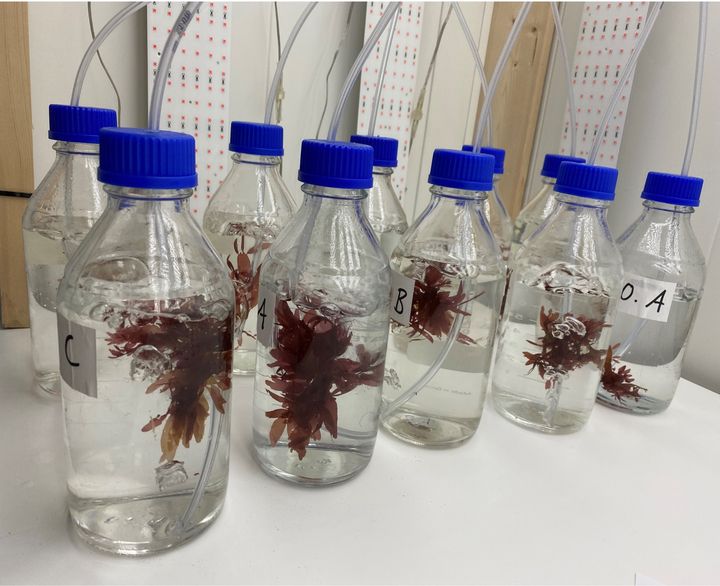
Dulse, or Palmaria palmata in Latin, is a red algae that has a relatively high value compared to other macroalgae and is commonly used in food products.
Senior scientist Philip James and colleagues have investigated the necessary conditions to successfully produce dulse with good growth rates and nice colour in the discharge water from land-based salmon production using recirculated water systems (RAS).
− I think this could be a win-win for both salmon producers, new businesses and the environment, says James.
This is what the scientists have found
In the trial, discharge water from SalMar’s land-based facility was used to grow dulse. The research results show that:
- Dulse grew best on 50 percent discharge water from RAS from this facility. That is compared to seawater, 25 percent and 100 percent discharge water from RAS.
- Results show that a dilution rate of 50 percent gave the highest removal efficiency of ammonia and nitrate for this facility. However, for phosphate removal somewhere between 25 and 50 percent RAS water was most efficient.
- Dulse grew equally well in salinity ranging from brackish water to full seawater (equivalent to 10-32 grams salt per kg seawater).
Striking potential
The results show that for every kilo of fish feed used in RAS salmon farming, 257 grams of dulse could be produced. With Norway’s land-based salmon industry consuming around 100,000 tonnes of feed annually, the nutrients in discharge water could provide everything needed for a substantial seaweed industry.
“This underlines the potential for both macroalgae cultivation and utilising RAS nutrients in discharge water as a valuable resource” James says and underlines that challenges remain.
In follow up projects, the scientists will also be testing dulse grown in discharge water from RAS water for nutritional benefits as well as any potential harmful compounds.
The results are from the ValueSøl research project, supported by the Regional Research Fund ARCTIC (RFF). Nofima is working together with the Norwegian University of Life Sciences (NMBU) and SalMar as project partners.
Keywords
Contacts
Reidun Lilleholt Kraugerud
Tel:48197382reidun.lilleholt@nofima.noPhilip JamesSenior ResearcherNofima
Tel:+47 481 68 263philip.james@nofima.nonofima.no/ansatte/philip-john-james/Images
Links
About Nofima
The Norwegian food research institute Nofima provides research based knowledge and innovations for actors in all parts of the food systems.

Subscribe to releases from Nofima
Subscribe to all the latest releases from Nofima by registering your e-mail address below. You can unsubscribe at any time.
Latest releases from Nofima
Klare råd for å få ungdom til å velge sjømat20.4.2026 14:45:45 CEST | Pressemelding
Prioriter pris! Få bort fiskebein og vond lukt. Og få influensere på banen!
Har du nok mat i beredskapslageret?16.4.2026 06:30:00 CEST | Pressemelding
Lurer du på hvor mye du skal handle til beredskapslageret? Her får du Nofima-forskernes råd om hvilken mat, og hvor mye mat som er lurt å ha dersom en krise oppstår.
Fish residuals may hold the key to male fertility13.4.2026 08:44:21 CEST | Press release
Nofima scientists are developing fertility supplements for men made from salmon heads.
Lite kunnskap om hva laksen spiser9.4.2026 11:01:27 CEST | Pressemelding
Visste du at om lag 70 prosent av fôret til oppdrettslaks består av planter? Hvis ikke, er du i godt, internasjonalt selskap.
Slik skal de øke fertiliteten hos europeiske menn30.3.2026 05:00:00 CEST | Pressemelding
Nofima-forskere er i gang med å utvikle fertilitetspiller til menn laget av laksehoder.
In our pressroom you can read all our latest releases, find our press contacts, images, documents and other relevant information about us.
Visit our pressroom