
Fish may turn yellow if frozen too fresh
What is the optimal point in time to freeze fish? At least not when it is too fresh, shows new research from Nofima.
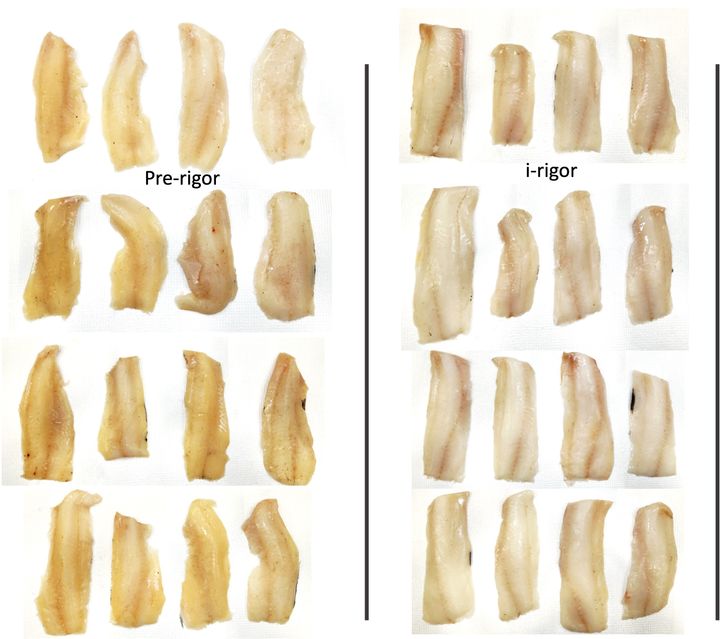
Surprised? Entirely understandable. So were the researchers.
We are used to thinking “The fresher, the better” when it comes to food – and perhaps especially seafood. But look at the picture: haddock that was processed and frozen pre-rigor – that is, so fresh that rigor mortis had not yet set in – consistently turned yellow after just 20 weeks in frozen storage.
“Yellowing caused by ‘rigor energy’ has not been described in scientific literature. It is likely that the industry has not been fully aware of how significant this can be,” says Nofima researcher Svein Kristian Stormo.
By contrast, haddock frozen post-rigor showed no signs of discolouration.
Drip loss and quality
The project “Effect of rigor state before freezing of cod and haddock raw material” was carried out by researchers from Nofima, supported by the Båtsfjord trade fisheries group and Bluewild in Ålesund. Their aim was to document how the timing of freezing affects yield, quality and consumer appeal.
They studied the differences between fish frozen pre-rigor, in-rigor and post-rigor, and measured thawing loss, subsequent drip loss, and sensory qualities such as texture and colouration following chilled storage.
The differences in rigor status are described as pre-rigor, in-rigor and post-rigor – before, during, and after rigor mortis in the fish muscle. The researchers wanted to establish the effects of rigor status on thawing loss, subsequent drip loss, as well as sensory properties such as colour and texture subsequent to chilled storage after frozen storage.
The project is funded by FHF – The Norwegian Seafood Research Fund.
Project leader Svein Kristian Stormo, one of Norway’s foremost experts on freezing and thawing raw material, had expected that the level of liquid loss would prove the most interesting finding in the study.
“But I was wrong. What we in technical terms call thawing and drip loss of the raw material is indeed highly important to document. But the most surprising and interesting result was the discolouration,” says Stormo.
A financial risk for the industry
Both liquid loss and discolouration are highly unfavourable from a consumer perspective. The researcher also stresses that such deviations can lead to significant financial losses for the industry.
“The challenge is twofold. There is major focus on quality – on freezing the raw material as fresh as possible. But in this case, that very approach causes greater challenges with increased liquid loss and discolouration. It is important that the industry is aware of this problem and, in the long term, finds the best solutions to minimize such effects,” he says.
Historically, much of the fish frozen onboard vessels has been handled in ways that suggest relatively little of the fish has actually been pre-rigor at the time of freezing. However, there is much to indicate that opportunities to freeze pre-rigor raw material are increasing going forward.
“This is due to new routines with smaller hauls, better onboard handling, as well as an increase in the proportion of live deliveries to land-based facilities. In addition, cod farming will bring pre-rigor raw material handling further into focus,” says Stormo.
With greater emphasis on producing high-quality frozen raw material comes the need for fundamental knowledge of how rigor status affects raw material during freezing.
“In the first instance, it will be useful to conduct thorough documentation through controlled trials with both cod and haddock. These should monitor the effect that varying degrees of freshness have on raw material during freezing and frozen storage,” says Stormo.
Timing is key
When it comes to liquid loss – and therefore also loss of weight and profitability from the fish – the experiments clearly showed that there may be good reasons to wait until the fish has passed the first phase of rigor before being frozen. But it is equally important to carefully monitor the quality of the raw material.
“The results show that freezing pre-rigor raw material leads to significantly higher liquid release upon thawing. This applies to both haddock and cod, but in our experiment the effect with haddock disappeared after eight weeks of frozen storage. With cod, however, the increased liquid loss persisted throughout an entire year of frozen storage,” the researcher explains.
“Delaying freezing is one solution to avoiding this effect, but at the same time other degrading effects will take hold if the period is too long. For quality and practical reasons, it is essential to establish the optimal point in time for freezing,” he concludes.
Main findings of the project
- Haddock frozen pre-rigor developed yellow discolouration visible after 20 weeks in frozen storage.
- Both whole and filleted haddock developed discolouration.
- Cod did not turn yellow in the same way as haddock, but earlier research has shown it can, depending on the fish’s condition.
- Both pre-rigor frozen haddock and cod showed significantly higher liquid loss upon thawing, but this effect disappeared after a relatively short period in frozen storage for haddock. For cod, the effect remained pronounced even after one year of frozen storage.
Facts about rigor mortis
Rigor (mortis) is the Latin term for the phenomenon of muscular stiffening after death. It is a gradual process, but the organism is commonly referred to as “in rigor” when the stiffening of the musculature has become noticeable.
For fish such as cod, this can occur relatively quickly after death (in less than two hours), but sometimes it can take up to a full day before the fish becomes stiff.
Raw material in the period before the onset of clear rigidity is often referred to as pre-rigor raw material.
The length of the rigor process is highly variable and influenced by factors such as temperature, stress levels and condition.
The fish leaves rigor when stiffening ceases, which usually happens within one to three days. At this stage, the raw material is referred to as post-rigor.
eller
What is rigor mortis?
Rigor mortis is the stiffening of the muscles following death. For fish such as cod, it may start within two hours but can also take a full day to set in.
- Fish before stiffness sets in is called pre-rigor.
- When stiffness is clearly noticeable, the fish is in-rigor.
- After one to three days, when stiffness subsides, the fish enters the post-rigor stage.
-
The length of the rigor process depends on factors such as temperature, stress and physical condition of the fish.
Keywords
Contacts
Anne-May Johansen
Tel:+47 958 47 544anne-may.johansen@nofima.noSvein Kristian Stormo
Tel:+47 971 64 669svein.stormo@nofima.noImages
About Nofima
The Norwegian food research institute Nofima provides research based knowledge and innovations for actors in all parts of the food systems.

Subscribe to releases from Nofima
Subscribe to all the latest releases from Nofima by registering your e-mail address below. You can unsubscribe at any time.
Latest releases from Nofima
Skit inn, skit ut sier pukkellaksforsker22.8.2025 07:00:00 CEST | Pressemelding
Det myldrer av pukkellaks i elver i Troms og Finnmark. Folk klarer ikke å håndtere mengden, og da blir kvaliteten fort dårlig, hevder pukkellakseforsker i Nofima.
38 millioner daglige måltider sjømat ignorert: - Store hull i matberedskapen15.8.2025 08:48:11 CEST | Pressemelding
Hver dag produserer og eksporterer Norge 38 millioner måltider med sjømat. Likevel er sjømat og sjømatproduksjon så vidt nevnt i analyser av matberedskapen i landet. Et paradoks fire tunge forskningsmiljø nå skal belyse grundig.
Matfaglig kompetanse gir lokalmaten kraft og styrker beredskapen11.8.2025 09:11:09 CEST | Kronikk
Norsk matberedskap krever mer enn lager og råvarer – det handler om kunnskapen som gir ferske råvarer holdbarhet, kvalitet og verdi. Uten folk med fagkompetanse står både produksjon og beredskap svakere.
Scientists create healthy salmon feed from polluting CO₂30.6.2025 10:36:26 CEST | Press release
Polluting CO₂ is turned into nutritious feed for farmed salmon. Science fiction? Absolutely not. All it takes are three innovative research environments, a visionary actor in the heavy metal industry, and large quantities of microalgae.
“Doktor tare” kan bidra til å lage trygge porsjonstørrelser på tareprodukter27.6.2025 07:00:00 CEST | Pressemelding
Hils på «Doktor tare» – Randi Sund. Gjennom arbeidet med sin ferske PhD har hun ervervet kunnskap som kan hjelpe både produsenter, matindustri og forbrukere til å velge trygge størrelser på porsjoner av tare.
In our pressroom you can read all our latest releases, find our press contacts, images, documents and other relevant information about us.
Visit our pressroom