
Salmon secrete substances that attract sea lice
6.12.2024 13:04:53 CET | Nofima | Press release
New research has enhanced our understanding of why sea lice are predominantly attracted to salmon.
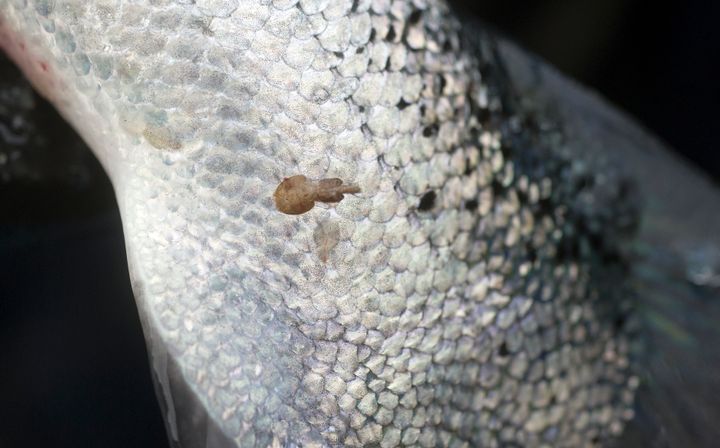
The study investigates the chemicals released by Atlantic salmon that serve as attractants to these parasites.
The encounter between a salmon louse and its host begins when the louse is in its free-swimming larval stage, known as a copepodite. But being tiny organisms in a vast ocean, how do they locate salmon as their host?
"Chemical signalling is believed to play a key role in host-parasite communication, and scientists have confirmed this," says Nicholas Robinson from Nofima.
Will enhance resistance to sea lice
Robinson is coordinating the CrispResist project, which brings together a leading team of scientists from Norway, the UK, USA, Canada, Sweden and Australia. Their goal is to uncover the mechanisms behind cross-species variation in host resistance to sea lice and apply this knowledge to enhance Atlantic salmon resistance in aquaculture.
A crucial objective is to identify and document genes and mechanisms responsible for the difference in sea lice resistance between salmonid species. It is well-established that certain Pacific salmon species are resistant to sea lice and can kill them in the early stages of parasitism, whereas Atlantic salmon are highly susceptible.
Senior fish health scientist Aleksei Krasnov at Nofima is involved in studies of chemical communication between lice and salmon. Working with the global team, Krasnov identified putative semiochemicals or compounds of biological origin that affect the behaviour of animals of the same or other species. The type of semiochemicals called kairomones help lice find salmon by scent.
Tested lice behaviour
The discovery involved a wide range of chemical analyses and lice behaviour tests. Water that was conditioned with Atlantic salmon, Pacific salmons and other fish species was analysed. Twenty-one candidate semiochemicals were selected for lice behaviour tests.
Additionally, mucus from Atlantic salmon families with high and low resistance to lice was studied to determine whether resistance could be linked to the chemical composition of the mucus. Behavioural tests were carried out in Norway and a few in Sweden using different methods.
The research showed that water conditioned only with salmon stimulated copepodite activity, confirming the presence of kairomones. Interestingly, conditioned water also contained compounds that deterred lice, suggesting that Atlantic salmon can repel lice as well.
Moreover, the tests suggested that semiochemicals may be produced in various tissues of Atlantic salmon, especially the skin.
Salmon from families susceptible to sea lice were found to produce mucus that had a higher stimulatory effect on lice than salmon from families with high resistance to lice.
Future Research
One of the key outcomes of the study was the identification of compounds for further research. "Overall, the findings suggest that host-parasite communication is highly complex and likely involves multiple cues," says Krasnov.
Krasnov believes that developing molecular tests is the most promising approach for continuing semiochemical research in this field.
The project CrispResist is financed by the Norwegian Seafood Research Fund – FHF. The project is a collaboration between 12 partners from science and industry. In particular, Rothamsted Research (UK), University of Gothenburg (Sweden), Bigelow Laboratory of Ocean Science (USA) and Nofima (Norway) have contributed to this part of the project.
Keywords
Contacts
Reidun Lilleholt Kraugerud
Tel:48197382reidun.lilleholt@nofima.noAleksei KrasnovNofima, avdeling Fiskehelse
Tel:+47 64 97 04 84aleksei.krasnov@nofima.nonofima.no/ansatte/aleksei-krasnov/Nicholas RobinsonNofima - avd. Avl og genetikk
nicholas.robinson@nofima.nonofima.com/employee/nicholas-andrew-robinson/Images
Links
About Nofima
The Norwegian food research institute Nofima provides research based knowledge and innovations for actors in all parts of the food systems.

Subscribe to releases from Nofima
Subscribe to all the latest releases from Nofima by registering your e-mail address below. You can unsubscribe at any time.
Latest releases from Nofima
Lukt avgjør om kyllingen havner i panna eller søpla2.10.2026 07:00:00 CEST | Pressemelding
Fersk kyllingfilet kan begynne å lukte annerledes før holdbarhetsdatoen er passert, men den satte holdbarhetsdatoen kan også være kortere enn nødvendig. Det viser seg at både bakteriene i fileten og temperaturen under lagring henger sammen med når forbrukere sier nei takk.
Salmon gills respond to climate stress before damage becomes visible25.9.2026 09:07:49 CEST | Press release
Marine heatwaves and more frequent jellyfish blooms pose a threat to farmed fish. A new study by Norwegian and Spanish researchers shows that salmon gills respond rapidly as the sea warms. Marine heatwaves leave biological traces before the fish show any signs of damage.
Laksens gjeller reagerer på klimastress før skader blir synlige25.9.2026 08:37:36 CEST | Pressemelding
Marine hetebølger og hyppigere manetoppblomstringer er en trussel for oppdrettsfisk. En ny studie fra norske og spanske forskere viser at når havet blir varmere, reagerer laksens gjeller raskt. Marine hetebølger setter biologiske spor før fisken viser tegn til skade.
Major funding for the development of sustainable ingredients and aquafeeds24.9.2026 13:42:45 CEST | Press release
The Research Council of Norway today awarded NOK 1.24 billion to strengthen Norwegian research and innovation. Nofima is hosting one of the 18 funded projects, allowing them to strengthen the work in Aquaculture Technology Centre.
Stor bevilgning til fôrteknologi24.9.2026 10:40:31 CEST | Pressemelding
Forskningsrådet har i dag tildelt 1,24 milliarder i midler til styrking av norsk forskning og innovasjon. Nofima er vertskap for ett av 18 sentre, og kan med det styrke satsningen på utvikling av bærekraftig fôr.
In our pressroom you can read all our latest releases, find our press contacts, images, documents and other relevant information about us.
Visit our pressroom